
Mandalay Travel Guide
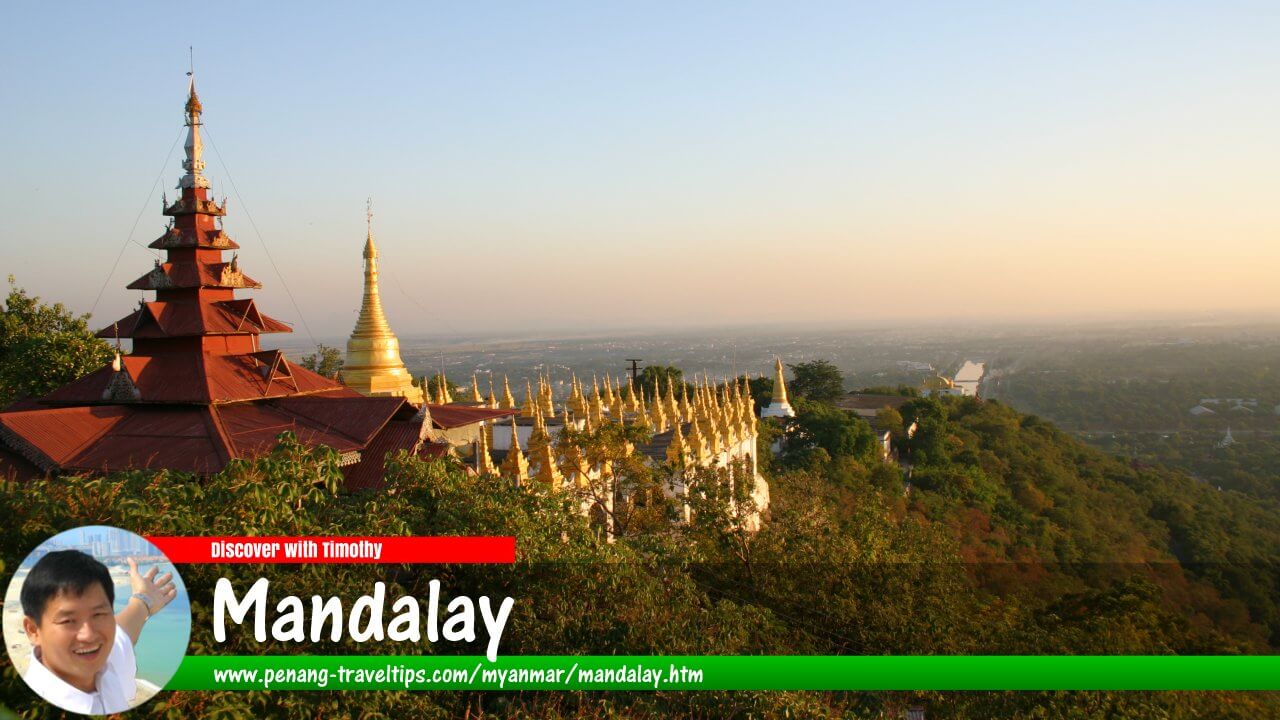 Mandalay (22 November 2003)
Also available: Mandalay (Malay Edition)
Introduction to Mandalay
Mandalay (မန္တလေး) is the second-largest city in Myanmar and one of the country's most important cultural centres. Located on the eastern bank of the Irrawaddy River, Mandalay is known for its royal heritage, Buddhist traditions, traditional arts and crafts, and its role as the last royal capital of Myanmar.
Unlike Yangon, which developed as a colonial commercial centre, Mandalay represents the historical identity of the Burmese monarchy. The city was founded in 1857 by King Mindon of the Konbaung Dynasty, who moved the royal capital from Amarapura to a new city at the foot of Mandalay Hill.
Today, Mandalay remains a destination where visitors can experience Myanmar's traditional culture through its monasteries, pagodas, markets, craftsmen and religious institutions.
Origin and Meaning of the Name Mandalay
The name Mandalay comes from Mandalay Hill (မန္တလေးတောင်), the prominent hill located northeast of the city.
The exact linguistic origin of the name has different interpretations. One explanation is that it is derived from the Pali word mandala, meaning a circular or sacred area, reflecting the hill's religious significance. Another interpretation connects the name with traditional Burmese words describing the hill and its surrounding landscape.
Before the city was founded, Mandalay Hill was already regarded as a sacred site in Buddhist tradition. According to local belief, the Buddha visited the area and made a prophecy that a great city would one day be established there as an important centre of Buddhism.
When King Mindon established the new royal capital in 1857, the city took the name Mandalay from the sacred hill that overlooked it.
Mandalay as the Last Royal Capital of Myanmar
Mandalay holds a special place in Myanmar's history because it was the final capital of the Burmese monarchy before the country came under British rule in 1885.
During the reign of King Mindon and his successor King Thibaw, Mandalay became a centre of royal power, Buddhist learning, literature, traditional arts and craftsmanship.
The construction of the Mandalay Palace, monasteries and pagodas during this period reflected the ambition of the Konbaung Dynasty to create a city that represented Burmese culture and Buddhist values.
Why Visit Mandalay?
Mandalay offers a different experience from other major Myanmar destinations. While Yangon is known for its colonial architecture and Bagan for its ancient temples, Mandalay provides a deeper connection to Myanmar's royal and cultural traditions.
The main reasons to visit Mandalay include:
- Royal heritage: Mandalay was the last seat of Burmese kings and remains closely associated with Myanmar's monarchy.
- Buddhist traditions: The city is home to some of Myanmar's most important religious sites, including Mahamuni Buddha Temple and Kuthodaw Pagoda.
- Traditional craftsmanship: Mandalay is famous for marble carving, gold leaf production, wood carving and other traditional arts.
- Cultural experiences: Visitors can observe monasteries, markets, workshops and everyday life that preserve Myanmar's traditions.
- Gateway to historic towns: Mandalay is the base for visiting nearby destinations such as Amarapura, Inwa and Sagaing.
Mandalay Today
Modern Mandalay is a busy and rapidly developing city, combining traditional Burmese culture with contemporary urban life. Its streets are filled with markets, restaurants, workshops and religious sites that reflect the diversity of the city.
Although Mandalay has experienced challenges, including destruction during the Second World War and rapid urban growth in recent decades, it continues to be regarded as the cultural heart of Myanmar.
For travellers interested in history, religion, architecture and traditional Asian culture, Mandalay is one of the most rewarding cities to visit in Myanmar.
History of Mandalay
Mandalay (မန္တလေး) is a relatively young city by Myanmar standards, but it occupies an extremely important place in the country's history. Unlike ancient cities such as Bagan and Inwa, Mandalay was purposefully created in the 19th century as the final royal capital of the Burmese monarchy.
Before Mandalay was established, the royal capital of the Konbaung Dynasty had been located at Amarapura, a historic city south of present-day Mandalay. In 1857, King Mindon decided to move the capital to a new location at the foot of Mandalay Hill, creating what would become the last great royal city of Myanmar.
Foundation of Mandalay by King Mindon
King Mindon founded Mandalay in 1857 during his reign over the Konbaung Dynasty. The new city was planned according to traditional Burmese and Buddhist principles, with the royal palace positioned at the centre and the surrounding city arranged in a carefully organised layout.
The construction of Mandalay was part of King Mindon's vision to establish a new centre of Burmese culture, religion and learning. The king supported the building of monasteries, pagodas and institutions dedicated to Buddhist scholarship.
One of the most significant achievements of King Mindon's reign was the organisation of the Fifth Buddhist Council in Mandalay in 1871. The teachings of Buddhism were reviewed and inscribed onto 729 marble slabs, which are now preserved at Kuthodaw Pagoda, known as the world's largest book.
Mandalay During the Konbaung Dynasty
During the final decades of the Konbaung Dynasty, Mandalay became the centre of royal authority, traditional arts and Burmese culture.
The city attracted skilled craftsmen, religious scholars and artists. Traditional industries such as marble carving, gold leaf production, wood carving and textile weaving flourished during this period, many of which continue today.
The Mandalay Palace became the symbolic heart of the kingdom, serving as the residence of King Mindon and later King Thibaw, the last king of Myanmar.
The Fall of the Burmese Monarchy
In 1885, the British conquered Upper Burma during the Third Anglo-Burmese War. King Thibaw was captured and exiled to India, bringing the Konbaung Dynasty and the Burmese monarchy to an end.
Following the fall of the monarchy, Mandalay became part of British Burma. The royal palace was converted for military use, and the city gradually changed from a royal capital into a colonial-era administrative and commercial centre.
Mandalay During the Second World War
Mandalay suffered severe damage during the Second World War. The city was occupied by Japanese forces and later became a major battlefield between Japanese and Allied forces.
Much of the historic city, including the original wooden structures of Mandalay Palace, was destroyed during the fighting. After the war, the city was rebuilt, and the palace was later reconstructed based on historical records.
Mandalay After Independence
Myanmar gained independence from Britain in 1948, and Mandalay continued to develop as the cultural and economic centre of Upper Myanmar.
Although Yangon became the country's political capital, Mandalay retained its importance as a centre of Buddhism, traditional arts, education and trade.
Today, Mandalay remains one of the best places to experience Myanmar's traditional identity and continues to serve as a gateway to many historic destinations in the surrounding region.
Geography of Mandalay
Mandalay is located in central Myanmar on the eastern bank of the Irrawaddy River, the country's most important waterway. The city lies approximately 600 kilometres north of Yangon and serves as the main urban centre of Upper Myanmar.
To the northeast of the city stands Mandalay Hill, a 240-metre-high hill that dominates the city's landscape. The hill is not only a geographical landmark but also a sacred Buddhist site closely associated with the origin of the city's name.
The Irrawaddy River has played an important role in Mandalay's development. Historically, it provided a major route for transportation, trade and communication between different regions of Myanmar.
Climate of Mandalay
Mandalay has a tropical savanna climate and is one of the hotter cities in Myanmar. Temperatures can be high, especially during the dry season.
The year can generally be divided into three seasons:
- Cool season (November to February): The most comfortable period for visiting, with lower temperatures and less rainfall.
- Hot season (March to May): Temperatures can become extremely high, especially during the afternoon. Outdoor sightseeing may be tiring during the hottest hours.
- Rainy season (June to October): Rainfall is more frequent, although the surrounding countryside becomes greener.
The best time to visit Mandalay is generally between November and February, when the weather is more suitable for exploring temples, monasteries and outdoor attractions.
Mandalay Today
Modern Mandalay is a vibrant city where traditional Myanmar culture exists alongside rapid urban development. Its streets combine historic monasteries, busy markets, workshops, restaurants and residential neighbourhoods.
Despite the changes brought by modernisation, Mandalay remains the spiritual and cultural centre of Myanmar, making it an essential destination for travellers who want to understand the country's history beyond its famous temples and landscapes.
Getting to Mandalay
Mandalay (မန္တလေး) is one of Myanmar's main transport hubs and can be reached by air, road, rail and river. Its central location makes it an important gateway to Upper Myanmar.
Most international visitors arrive in Myanmar through Yangon, and then continue to Mandalay by domestic flight, train, bus or private vehicle. Travellers coming from other parts of Myanmar can also reach Mandalay through its extensive transport network.
By Air
The nearest airport serving Mandalay is Mandalay International Airport, located approximately 35 kilometres south of the city.
The airport handles domestic flights connecting Mandalay with Yangon and other major destinations in Myanmar. International flight connections have varied over time, so travellers should check the latest flight schedules before planning their journey.
From the airport, visitors can reach central Mandalay by taxi or arranged private transfer. Because the airport is located outside the city, the journey usually takes longer than travelling from Yangon International Airport to central Yangon.
From Yangon to Mandalay
Yangon and Mandalay are connected by several transport options. The best choice depends on the traveller's budget, available time and preferred level of comfort.
By Domestic Flight
Flying is the fastest way to travel between Yangon and Mandalay. The flight takes approximately one and a half hours, making it suitable for travellers who have limited time.
This option is especially convenient for visitors who want to maximise their sightseeing time in Mandalay.
By Train
The Yangon–Mandalay railway route is one of Myanmar's classic overland journeys. Train travel offers a slower but more traditional experience, allowing passengers to observe rural landscapes and everyday life outside the major cities.
However, Myanmar's trains are generally much slower than rail systems in countries such as Malaysia, Singapore or Japan. Travellers should be prepared for long journey times and varying levels of comfort.
By Bus
Long-distance buses are a popular option for travelling between Yangon and Mandalay. Modern express buses usually provide air conditioning and reclining seats, making them a practical choice for budget-conscious travellers.
Bus journeys are considerably longer than flights but are often much cheaper.
By Private Car with Driver
Hiring a private car with a driver is the most flexible option, especially for families, older travellers or visitors who want to combine Mandalay with nearby destinations.
A private vehicle allows travellers to stop at places of interest along the way and provides greater comfort compared with public transport.
Getting Around Mandalay
Mandalay is a large city, and its attractions are spread across different areas. Although the city centre follows a relatively organised grid layout, visitors will generally need some form of transport to move between major sights.
Private Car with Driver
For most international visitors, especially those travelling with family or older companions, a private car with driver is the most convenient way to explore Mandalay.
This is particularly useful because many visitors combine city sightseeing with trips to:
- Amarapura, including U Bein Bridge.
- Sagaing, known for its hills and monasteries.
- Inwa (Ava), the former royal capital.
A private vehicle also provides relief from Mandalay's hot climate, allowing visitors to travel comfortably between outdoor attractions.
Taxis
Taxis are available in Mandalay and are commonly used by visitors to travel between hotels and major attractions.
Unlike some major Asian cities, Mandalay does not have a comprehensive public transport system designed specifically for tourists. Visitors may need to negotiate fares before starting their journey.
Ride-Hailing Applications
Ride-hailing services may be available in Mandalay, although availability can vary. Travellers should check the latest situation after arrival.
Having the hotel address written in Burmese can be useful, as not all drivers may be familiar with English place names.
Motorbike Rental
Motorbikes are a common form of transport in Mandalay, and some travellers choose to rent one for greater independence.
However, visitors should consider traffic conditions, road safety and local driving habits before choosing this option. Those without experience riding in busy Asian cities may find a car or taxi more comfortable.
Bicycle
Cycling can be an enjoyable way to explore some parts of Mandalay, especially during the cooler months.
However, the city's heat, traffic and distances between attractions mean that bicycles may not be suitable for all travellers.
Using Mandalay as a Base for Nearby Destinations
One of Mandalay's greatest advantages is its location near several historically important destinations. Many travellers stay in Mandalay and make day trips to surrounding towns.
- Amarapura: Former royal capital, famous for U Bein Bridge and historic monasteries.
- Sagaing: A spiritual centre known for hundreds of monasteries and pagodas spread across Sagaing Hill.
- Inwa (Ava): Former royal capital known for ancient ruins, monasteries and traditional rural landscapes.
These destinations will each have their own dedicated travel guides on Penang Travel Tips, while this Mandalay page serves as the main gateway guide.
Accessibility for Older Travellers
Mandalay can be visited comfortably by older travellers with proper planning.
Visitors who prefer a more relaxed experience should consider:
- Hiring a private car with driver rather than relying entirely on public transport.
- Planning fewer attractions each day to avoid fatigue.
- Visiting outdoor sites during the morning or late afternoon.
- Choosing accommodation in a convenient central location.
With its relatively flat terrain and wide streets, Mandalay is easier to navigate than some historic destinations, although the heat and walking required at temples and monasteries should be taken into consideration.
Accommodation in Mandalay
Mandalay (မန္တလေး) offers a wider range of accommodation compared with many other destinations in Myanmar. As a major cultural, commercial and transport centre, the city has hotels, guesthouses and serviced accommodation catering to different types of travellers.
Most visitors choose to stay in central Mandalay because it provides convenient access to restaurants, markets, transport options and many of the city's main attractions.
Best Areas to Stay in Mandalay
Downtown Mandalay
Downtown Mandalay is the most convenient area for many visitors, especially first-time travellers. The area has a good selection of hotels, restaurants, cafes, markets and transport options.
Advantages of staying downtown include:
- Easy access to restaurants and shops.
- Convenient transport connections.
- Closer to attractions such as Mandalay Palace, Zay Cho Market and several monasteries.
Near Mandalay Palace
The area around Mandalay Palace is suitable for visitors who want to be close to some of the city's most important historic landmarks.
This area offers a quieter environment compared with some busier parts of downtown, while still being within easy reach of restaurants and transport.
Near Mandalay Hill
Staying near Mandalay Hill provides convenient access to one of the city's most famous landmarks. The area is suitable for travellers who enjoy visiting religious sites and prefer a slightly more relaxed atmosphere.
Types of Accommodation in Mandalay
Luxury Hotels
Mandalay has several higher-end hotels offering modern facilities, restaurants, swimming pools and services suitable for international travellers.
These hotels are suitable for visitors who prioritise comfort, especially families and older travellers.
Mid-Range Hotels
Mid-range hotels are popular among most independent travellers. They usually provide comfortable rooms, air conditioning, breakfast and assistance with arranging transport or tours.
Budget Accommodation
Budget hotels and guesthouses are available for backpackers and travellers who prefer to spend more on experiences rather than accommodation.
When choosing budget accommodation, visitors should check recent reviews, especially regarding cleanliness, air conditioning, water supply and location.
Food in Mandalay
Mandalay is one of the best cities in Myanmar for experiencing the country's diverse food culture. Its cuisine reflects Burmese, Shan, Chinese, Indian and other regional influences.
Because Mandalay has long been a centre of trade and migration, visitors can find a wider variety of food compared with smaller Myanmar towns.
Local Food to Try in Mandalay
- Mandalay-style Burmese cuisine: Traditional meals usually include rice, curries, vegetables, soups and side dishes with flavours influenced by local ingredients.
- Shan cuisine: Shan noodles, rice dishes and fermented foods are popular throughout Myanmar and are widely available in Mandalay.
- Mohinga: Myanmar's famous fish noodle soup, often eaten as breakfast but available throughout the day.
- Lahpet Thoke: A traditional fermented tea leaf salad combining savoury, sour and crunchy flavours.
- Chinese-influenced dishes: Mandalay has a significant Chinese community, and Chinese restaurants are common throughout the city.
- Traditional sweets and snacks: Local markets and tea shops offer many Myanmar snacks that are worth trying.
Is Food in Mandalay Spicy?
Compared with some Southeast Asian cuisines, Myanmar food is generally not extremely spicy. The flavours usually come from garlic, onions, herbs, spices, fermented ingredients and cooking techniques rather than heavy use of chilli.
However, some dishes may be served with chilli condiments separately, allowing diners to adjust the level of spiciness according to their preference.
Travellers from Malaysia who are accustomed to spicy food will generally find Myanmar cuisine approachable, although the flavours may be different from Malaysian dishes.
Halal Food in Mandalay
For Muslim travellers from Malaysia, Mandalay is one of the easier places in Myanmar to find halal or Muslim-friendly food compared with smaller towns.
Mandalay has a Muslim community, including people of Indian, Burmese Muslim and other backgrounds. As a result, visitors can find restaurants serving Indian Muslim cuisine, biryani, naan, curries and other dishes that may be suitable for Muslim travellers.
However, travellers should remember that halal standards and certification practices may differ from Malaysia. Those who require strict halal compliance should confirm with the restaurant before ordering.
Tips for Muslim Travellers
- Look for Muslim-owned restaurants or restaurants recommended by local Muslim communities.
- Ask about ingredients and preparation methods when uncertain.
- Carry some halal snacks for convenience during day trips.
- Use hotel staff or local guides to identify suitable restaurants.
Tea Shops and Local Dining Experience
One of the best ways to experience daily life in Mandalay is by visiting a traditional Myanmar tea shop.
Tea shops are important social spaces where locals gather for conversation, breakfast and snacks. Visitors can enjoy tea, noodles, pastries and simple dishes while observing everyday life.
For travellers interested in culture, these small local experiences can be just as memorable as visiting famous monuments.
Drinking Water and Food Safety
Visitors should take normal precautions when eating and drinking in Mandalay:
- Drink bottled water from reliable sources.
- Choose restaurants that are busy with local customers.
- Be careful with raw food and uncooked ingredients.
- Carry basic medication for stomach discomfort if needed.
With its variety of accommodation and food options, Mandalay is one of the most comfortable cities in Myanmar for international visitors.
Places of Interest in Mandalay
Mandalay (မန္တလေး) is one of Myanmar's richest cultural destinations, with royal buildings, Buddhist monuments, monasteries and traditional craft centres. Most of the city's important sights can be explored within two to three days, although visitors who want a deeper cultural experience may wish to spend longer.
The following are some of the most significant attractions within Mandalay city.
Mandalay Palace
Mandalay Palace (မန္တလေးနန်းတော်) was the royal residence of the last Burmese kings and the centre of the Konbaung Dynasty's final years.
Built in the 19th century by King Mindon, the original palace complex represented the power and traditions of the Burmese monarchy. Much of the original wooden structure was destroyed during the Second World War, but the palace was later reconstructed based on historical records.
Today, Mandalay Palace is one of the city's most recognisable landmarks and provides visitors with a glimpse into Myanmar's royal past.
Mandalay Hill
Mandalay Hill (မန္တလေးတောင်) is the sacred hill that gave the city its name and is one of Mandalay's most famous viewpoints.
Standing approximately 240 metres above the surrounding plain, the hill has been an important Buddhist pilgrimage site for generations. At the summit, visitors can enjoy panoramic views of Mandalay and the Irrawaddy River.
The hill is especially popular at sunrise and sunset when the city landscape is illuminated by softer light.
Mahamuni Buddha Temple
Mahamuni Buddha Temple (မဟာမုနိဘုရားကြီး) is one of the most revered Buddhist sites in Myanmar.
The temple is famous for housing the Mahamuni Buddha image, which is considered one of the country's most sacred Buddha images. Devotees traditionally apply gold leaf to the image as an act of devotion.
Beyond its religious importance, the temple offers visitors an opportunity to observe Buddhist traditions and daily worship practices in Myanmar.
Kuthodaw Pagoda
Kuthodaw Pagoda (ကုသိုလ်တော်ဘုရား) is known as the location of the world's largest book.
The complex contains 729 marble slabs inscribed with Buddhist scriptures, each housed inside its own small white stupa. The project was initiated by King Mindon following the Fifth Buddhist Council held in Mandalay in 1871.
The peaceful layout of the pagoda complex makes it one of the most memorable cultural sites in Mandalay.
Shwenandaw Kyaung Monastery
Shwenandaw Kyaung Monastery (ရွှေနန်းတော်ကျောင်း), also known as the Golden Palace Monastery, is one of the finest surviving examples of traditional Burmese wooden architecture.
The monastery is especially significant because it was once part of the royal palace complex. King Mindon used the building as his personal residence before it was moved outside the palace grounds after his death.
Its detailed teak carvings and traditional craftsmanship make it one of Mandalay's most impressive historic buildings.
Atumashi Kyaung Monastery
Atumashi Kyaung Monastery (အတုမရှိကျောင်း) means "The Incomparable Monastery" and was built by King Mindon in the 19th century.
The original monastery was one of the grandest religious buildings of its time. Although the structure suffered destruction and was later rebuilt, it remains an important example of Myanmar Buddhist architecture.
The monastery's spacious design and historical importance make it a worthwhile stop when exploring Mandalay's royal-era heritage.
Sandamuni Pagoda
Sandamuni Pagoda (စန္ဒာမုနိဘုရား) is located near Mandalay Hill and is known for its many white stupas surrounding a central pagoda.
The complex contains hundreds of marble slabs inscribed with Buddhist teachings, similar in concept to Kuthodaw Pagoda, although less well known among international visitors.
Its quieter atmosphere makes it a pleasant place for visitors who wish to explore Mandalay's religious heritage away from larger crowds.
Zay Cho Market
Zay Cho Market is one of Mandalay's most famous traditional markets and a good place to experience local life.
Visitors can find fresh produce, clothing, household items, snacks and local products while observing the daily activities of Mandalay residents.
For travellers interested in photography and authentic cultural experiences, local markets often provide some of the most memorable moments.
Day Trips from Mandalay
Mandalay is also the ideal base for exploring several important historic towns nearby. These destinations are often included in Mandalay itineraries but will have their own dedicated travel guides on Penang Travel Tips.
Amarapura
Amarapura was a former royal capital before the establishment of Mandalay. It is best known today for U Bein Bridge, the world's longest teak bridge, as well as historic monasteries and traditional communities.
Inwa (Ava)
Inwa (အင်းဝ) was one of Myanmar's most important royal capitals for several centuries. Today, visitors can explore its ruins, monasteries and peaceful countryside landscape.
Sagaing
Sagaing is a spiritual centre famous for its hills covered with monasteries, nunneries and pagodas. It offers some of the most beautiful views of the Irrawaddy River region.
How Many Days Are Needed to Explore Mandalay?
For first-time visitors, two to three days is generally sufficient to experience the main attractions within Mandalay city.
A possible schedule:
- Day 1: Mandalay Palace, Mandalay Hill, Shwenandaw Kyaung Monastery and Atumashi Kyaung Monastery.
- Day 2: Mahamuni Buddha Temple, Kuthodaw Pagoda, Sandamuni Pagoda and local markets.
- Day 3: Day trip to Amarapura, Inwa or Sagaing.
Travellers who enjoy history, photography and cultural exploration may find that Mandalay deserves more time, especially when combined with the surrounding historic towns.
Practical Travel Guide to Mandalay
Mandalay (မန္တလေး) is a rewarding destination, but good planning will make the experience much more enjoyable. The city is spread out, the weather can be hot, and many attractions involve walking in open areas or visiting active religious sites.
With the right preparation, Mandalay is suitable for a wide range of travellers, from independent explorers to families and older visitors.
How Many Days Should You Spend in Mandalay?
The ideal length of stay depends on whether you plan to explore only Mandalay city or include nearby historic destinations.
Two Days in Mandalay
Two days are sufficient to visit the main attractions within the city.
Suggested itinerary:
- Day 1: Mandalay Palace, Mandalay Hill, Shwenandaw Kyaung Monastery and Atumashi Kyaung Monastery.
- Day 2: Mahamuni Buddha Temple, Kuthodaw Pagoda, Sandamuni Pagoda, local markets and traditional craft areas.
Three to Four Days in Mandalay
A longer stay allows visitors to explore nearby historic destinations without rushing.
- Amarapura and U Bein Bridge.
- Inwa (Ava).
- Sagaing.
- Additional monasteries, markets and cultural sites in Mandalay.
Travellers interested in history, photography and traditional culture will appreciate having extra time in the region.
Best Time to Visit Mandalay
The best time to visit Mandalay is generally from November to February, when temperatures are cooler and rainfall is low.
- November to February: The most comfortable period for sightseeing, especially for outdoor attractions.
- March to May: The hottest period of the year. Afternoon sightseeing can be tiring due to high temperatures.
- June to October: The rainy season. Rain may affect outdoor activities, although the countryside becomes greener.
For visitors planning to climb Mandalay Hill, explore temple complexes or take day trips, the cooler months provide the most comfortable conditions.
What to Wear in Mandalay
Mandalay is a conservative city where Buddhist traditions remain important. Visitors should dress respectfully, especially when visiting temples and monasteries.
- Cover shoulders and knees when entering religious sites.
- Wear clothing that is comfortable for hot weather.
- Bring a hat, sunglasses and sunscreen for outdoor sightseeing.
- Wear footwear that is easy to remove because shoes must be taken off at pagodas and monasteries.
Light, breathable clothing is recommended because Mandalay can become very hot during the day.
Temple and Monastery Etiquette
Many of Mandalay's attractions are active religious places, not simply tourist sites. Visitors should respect local customs.
- Remove shoes and socks before entering pagoda areas.
- Avoid loud conversations inside religious compounds.
- Do not point feet towards Buddha images or religious objects.
- Ask permission before photographing monks or worshippers.
- Avoid touching religious objects unless permitted.
Respectful behaviour will help ensure that visitors have a more meaningful cultural experience.
Photography Tips in Mandalay
Mandalay offers excellent photography opportunities, from royal architecture and golden pagodas to everyday scenes in markets and monasteries.
Some of the best photography locations include:
- Mandalay Hill at sunrise or sunset.
- The wooden carvings of Shwenandaw Kyaung Monastery.
- The white stupas of Kuthodaw Pagoda and Sandamuni Pagoda.
- Traditional markets and craft workshops.
- The daily activities around Mahamuni Buddha Temple.
When photographing people, especially monks and worshippers, always be respectful and ask permission when appropriate.
Visiting Mandalay with Older Travellers or Limited Mobility
Mandalay can be visited comfortably by older travellers, but some planning is recommended.
Possible challenges include:
- Walking distances within large temple compounds.
- Hot weather and strong sunlight.
- Uneven surfaces in historic areas.
- Repeated removal of footwear at religious sites.
To make the journey more comfortable:
- Hire a private car with driver.
- Visit outdoor attractions early in the morning or late afternoon.
- Allow sufficient rest time between attractions.
- Carry drinking water and basic medication.
- Choose accommodation with convenient access to restaurants and transport.
Safety Tips in Mandalay
Mandalay is generally a welcoming city for visitors. However, travellers should take normal precautions as they would in any unfamiliar destination.
- Keep valuables secure in crowded areas and markets.
- Carry some Myanmar kyat in cash because card payments may not be widely accepted.
- Use reputable transport providers.
- Be cautious when crossing busy roads.
- Keep important documents safely stored.
Money and Connectivity
Travellers should carry enough local currency, as cash remains important in Myanmar. Exchange facilities and banking services may not be as convenient as in larger international destinations.
Mobile internet access is available in Mandalay, although visitors should check the latest situation regarding network coverage and availability of SIM cards.
Final Tips for Visiting Mandalay
Mandalay rewards visitors who take time to explore beyond the famous landmarks. While the city's major attractions are important, some of the most memorable experiences come from observing daily life — visiting a tea shop, watching craftsmen at work, exploring markets and interacting respectfully with local people.
For travellers who want to understand Myanmar's history, religion and traditional culture, Mandalay is not just a stopover. It is a destination worth experiencing slowly.
Final Notes on Visiting Mandalay
Mandalay (မန္တလေး) is one of Myanmar's most important cultural destinations and the country's last royal capital. While Yangon represents Myanmar's colonial and commercial history, and Bagan represents its ancient temple civilisation, Mandalay represents the traditions, beliefs and craftsmanship of the Burmese people.
Founded by King Mindon in 1857, Mandalay became the final seat of the Burmese monarchy and remains a centre of Buddhist learning, traditional arts and cultural heritage. The city's royal palace, monasteries and pagodas provide visitors with a deeper understanding of Myanmar's history.
Beyond its famous landmarks, Mandalay's charm lies in its living culture — the sound of temple bells, monks walking through monasteries, craftsmen creating traditional works of art, and local markets filled with everyday activities.
For first-time visitors to Myanmar, Mandalay offers a different perspective from other famous destinations. It is a city where history is not only preserved in monuments but continues to be part of daily life.
Summary of Mandalay Travel Information
- Location: Central Myanmar, on the eastern bank of the Irrawaddy River.
- Historical importance: Last royal capital of Myanmar and former centre of the Konbaung Dynasty.
- Recommended stay: Two to three days for Mandalay city; longer if including Amarapura, Inwa and Sagaing.
- Best time to visit: November to February, when the weather is cooler and more comfortable.
- Nearest airport: Mandalay International Airport.
- Getting around: Private car with driver, taxi, motorbike or organised tours.
- Main attractions: Mandalay Palace, Mandalay Hill, Mahamuni Buddha Temple, Kuthodaw Pagoda, Shwenandaw Kyaung Monastery and Atumashi Kyaung Monastery.
- Nearby destinations: Amarapura, U Bein Bridge, Inwa and Sagaing.
- Food: Wide variety of Burmese, Shan, Chinese and Indian-influenced cuisine. Muslim travellers have more options here compared with smaller Myanmar towns, but halal status should still be confirmed.
Future Mandalay Sight Guides
The following attractions in Mandalay will have their own dedicated travel guides on Penang Travel Tips, providing more detailed information about their history, architecture, visiting experience and practical tips:
- Atumashi Kyaung Monastery (အတုမရှိကျောင်း)
- Kuthodaw Pagoda (ကုသိုလ်တော်ဘုရား)
- Mahamuni Buddha Temple (မဟာမုနိဘုရားကြီး)
- Mandalay Hill (မန္တလေးတောင်)
- Mandalay Palace (မန္တလေးနန်းတော်)
- Shwenandaw Kyaung Monastery (ရွှေနန်းတော်ကျောင်း)
References
- Myanmar Ministry of Hotels and Tourism – General tourism information for Myanmar.
- UNESCO World Heritage Centre – Background information on Myanmar's cultural heritage.
- Encyclopaedia Britannica – Historical information on Myanmar, the Konbaung Dynasty and Mandalay.
- Historical studies on the Burmese monarchy, Buddhist traditions and the development of Mandalay.
Mandalay Travel Guide
Mandalay is more than the former capital of a kingdom. It is a city where Myanmar's history, religion, craftsmanship and traditions continue to live.
Whether visiting the golden pagodas, exploring royal heritage, discovering traditional arts or using the city as a base to explore nearby historic towns, Mandalay offers travellers a deeper appreciation of Myanmar's cultural identity.
