
Perlis Travel Guide
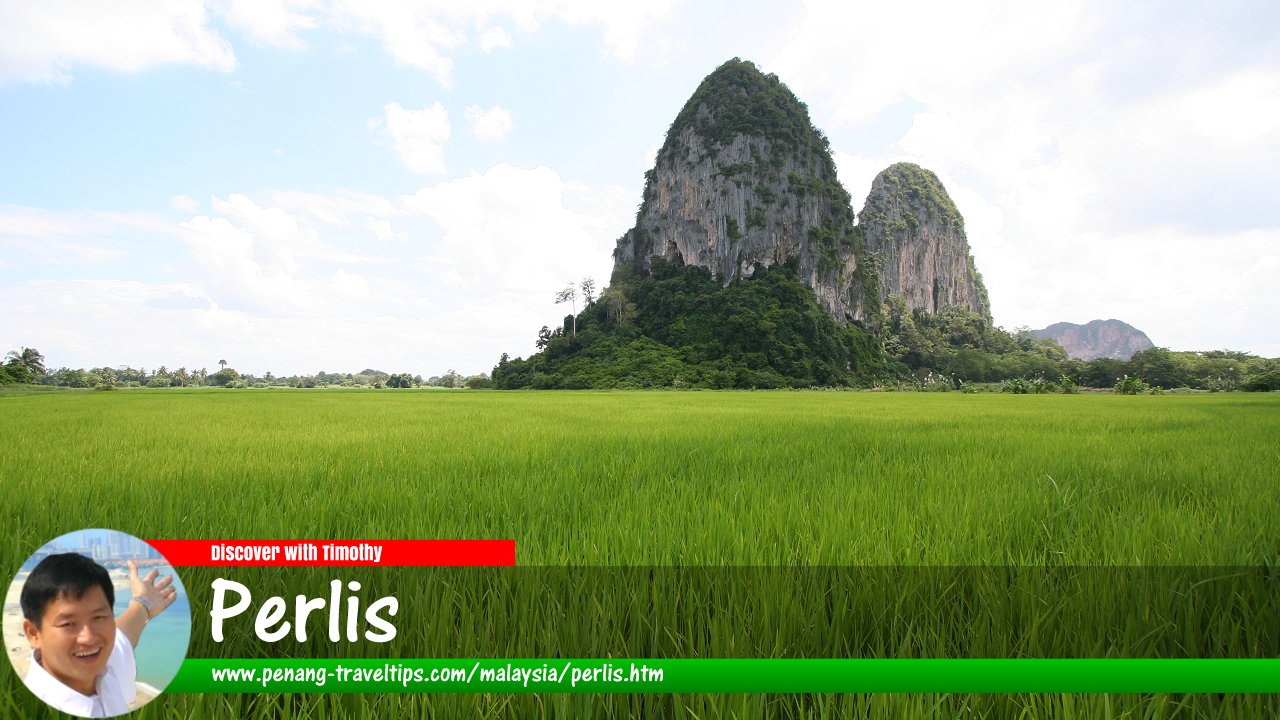 Perlis (1 November 2009)
Also available: Panduan Melawat Perlis
Perlis is a state on the northwestern coast of Peninsular Malaysia, and the smallest state in the country by both land area and population.1 Also known by its honorific title Perlis Indera Kayangan, the state covers roughly 818 square kilometres and sits at Malaysia's northernmost tip, bordered by the Thai provinces of Satun and Songkhla to the north and east, and by the Malaysian state of Kedah, of which it formed a part until 1842, to the south and west.2 Perlis is unique among Malaysian states in that it is not divided into formal administrative districts due to its small size, though it is subdivided into several smaller communes known as mukim.2 With a population estimated at around 292,700 as of the 2023 census, the state is home to Kangar, its capital and largest city, and Arau, the seat of the Raja of Perlis and the traditional royal capital.3 Despite its modest size, Perlis carries an outsized reputation as one of Malaysia's most fertile rice-growing regions and a centre of conservative Islamic scholarship.
Geography and Climate
Perlis occupies a compact stretch of Peninsular Malaysia's northwestern corner, characterised by fertile alluvial plains given over largely to paddy cultivation, interspersed with dramatic limestone hills and cave systems that distinguish its landscape from the flatter rice-growing plains of neighbouring Kedah.4 Much of the state's higher ground forms part of the Nakawan Range, a subrange of the Tenasserim Hills system that extends through southern Myanmar, southern Thailand, and into Peninsular Malaysia, with Mount Perlis, the state's highest point at 733 metres, forming a natural frontier with Thailand.2 The state's main port and ferry terminal is located at the small coastal village of Kuala Perlis, which serves as the principal departure point for ferries to Langkawi Island.2
Perlis experiences a tropical climate with generally warm, humid conditions year-round, though its position at the northern tip of the peninsula gives it a slightly more pronounced dry season than states further south, with the Northeast Monsoon between roughly November and March bringing comparatively lower rainfall to the state's paddy-growing plains.2
History
Origins within the Kedah Sultanate
Perlis was originally part of the Kedah Sultanate, though the territory occasionally came under the influence of Siam or Aceh over the centuries.1 Long before its formal separation, Sultan Dhiauddin II of Kedah bestowed the chieftainship of Arau on Syed Harun Jamalullail, father of the future first Raja of Perlis, as a wedding gift upon his marriage to the Sultan's daughter, Tengku Sofiah, establishing the family connection that would eventually give rise to Perlis's own ruling house.4
Siamese Rule and the Formation of a Separate Principality
After Siam conquered Kedah in 1821, British interests in neighbouring Perak felt increasingly threatened, prompting the 1826 Burney Treaty and later the Low Treaty, which formalised relations between the Malay states and Siam, their nominal overlord at the time.1 The exiled Sultan of Kedah spent twelve years unsuccessfully fighting for restoration before finally accepting Siamese terms in 1842 and returning to his throne.1 As part of this settlement, Siam separated Perlis into its own principality, directly vassal to Bangkok, and on 20 April 1843, Sayyid Hussain Jamalullail, paternal grandson of a Hadhrami Arab immigrant and maternal grandson of the Sultan of Kedah, was appointed by Siam as the first Raja of Perlis.4 His descendants, the House of Jamalullail, continue to rule the state to this day.
British Protection and the Twentieth Century
As with Kedah, the Anglo-Siamese Treaty of 1909 compelled Siam to relinquish its southern Malay vassal states to Great Britain, and the British subsequently installed a Resident in the royal capital of Arau.1 During the Second World War, Perlis was briefly returned to Siam as a reward for the country's alliance with Japan, though this annexation ended with the Japanese surrender in 1945, after which the state reverted to British administration.1 Perlis subsequently joined the Federation of Malaya in 1948 as one of the Unfederated Malay States, achieved independence alongside the rest of the federation on 31 August 1957, and became one of the thirteen states of Malaysia upon the formation of the wider federation in 1963.3
Government and Administration
Perlis is a constitutional monarchy headed by the Raja of Perlis, a title distinct from the "Sultan" used in most other Malay states, currently held by Tuanku Syed Sirajuddin Jamalullail, who has reigned since 2000.3 The Raja is drawn from the House of Jamalullail, the same family lineage established when Sayyid Hussain Jamalullail was appointed the state's first ruler in 1843.4 Executive government is led by the Menteri Besar, the state's chief minister, who governs together with the Perlis State Executive Council and is accountable to the Perlis State Legislative Assembly.3
Unlike every other state in Malaysia, Perlis has no formal district-level administrative divisions, a direct consequence of its small size, though it remains subdivided into several mukim, or communes, for local administrative purposes.2 Kangar serves as the seat of state government and the state's commercial centre, while Arau, a short distance away, remains the ceremonial and residential seat of the Raja.3
Economy
Agriculture forms the backbone of the Perlis economy, and the state is widely regarded as one of Malaysia's premier rice-growing regions, with its fertile alluvial plains supporting extensive paddy cultivation that contributes significantly to national rice production.5 Small-scale tin mining has historically taken place within the state, though it plays a far more modest role in the modern economy than agriculture.5 In recent decades, the presence of Universiti Malaysia Perlis and Politeknik Tuanku Syed Sirajuddin, both based in the developing area of Pauh Putra, has introduced a growing higher education sector to the state, generating student housing, retail, and services demand that has helped diversify the local economy beyond its traditional agricultural base.2 Cross-border trade with Thailand, particularly through the border town of Padang Besar, also plays a meaningful role in the state's commercial activity, given Perlis's position as Malaysia's northern gateway.2
Demographics and Religion
Perlis has a predominantly Malay population, a reflection of its largely agrarian, rural character compared to the more industrialised and ethnically diverse states further south.4 Malay is the primary language spoken throughout the state, with the distinctive Perlis dialect of Kedah Malay, known locally as Peghelih, commonly used in everyday speech.2
Islam is the majority religion, and Perlis has developed a particular reputation within Malaysia for its comparatively conservative and scripturally-oriented approach to Islamic administration, associated in part with the state's Mufti's office and its emphasis on returning religious practice to primary Islamic sources.6 Despite this administrative conservatism, public life in the state is generally understood to remain calm and orderly, with religious observance expressed more through everyday administrative and educational structures than through public displays.6 Small Chinese and other minority communities are present, particularly around Kangar and the university township of Pauh Putra, supporting a modest number of churches and temples alongside the state's Muslim majority.7
Attractions
Though Perlis rarely features prominently on Malaysia's mainstream tourism circuit, the state offers a handful of distinctive natural and cultural attractions worth visiting, particularly for travellers interested in caves, wildlife, and quieter rural landscapes.2
- Gua Kelam — a striking limestone cave system near Kaki Bukit, accessible via a lit wooden walkway running through the cave, and one of the state's best-known tourist sites.2
- Perlis State Park — a protected forest reserve offering hiking trails and a glimpse of the limestone hill ecosystems that define much of the state's terrain.2
- Perlis Snake and Reptile Sanctuary — a research centre and sanctuary located at Sungai Batu Pahat, home to a wide variety of snake species and a popular stop for visitors interested in local wildlife.2
- Kuala Perlis — a coastal town and the main departure point for ferries to Langkawi, also known for its seafood and waterfront atmosphere.2
Visitors travelling through Perlis en route to Langkawi frequently combine a short stopover in the state with their island trip, taking advantage of the ferry connection from Kuala Perlis while sampling the state's rice-paddy scenery and limestone hill landscapes along the way.
Cuisine
Perlis shares much of its culinary tradition with neighbouring Kedah, reflecting a shared Malay food culture rooted in the region's rice-growing economy. Dishes built around freshly harvested rice, along with regional specialities such as laksa Kedah-style, fresh seafood from the state's coastal areas, and locally grown fruit, feature prominently in everyday cooking across the state.5 As one of Malaysia's principal rice-producing regions, Perlis takes particular pride in the quality of its local rice, which forms the everyday staple across virtually every meal eaten in the state.
Education
Higher education has become an increasingly significant part of Perlis's development in recent decades, centred on Universiti Malaysia Perlis, commonly known as UniMAP, a public technical university with a growing footprint across several campuses in the state, alongside Politeknik Tuanku Syed Sirajuddin, both concentrated in the developing township of Pauh Putra.2 The presence of these institutions has brought a noticeably younger, more diverse population into what remains an otherwise predominantly rural and agrarian state, supporting new housing, retail, and student services that have gradually reshaped parts of the local economy around Kangar and its surrounding areas.
Festivals and Cultural Life
As a predominantly Malay and Muslim state, Perlis observes the major Islamic festivals of Hari Raya Aidilfitri and Aidiladha as its most significant annual celebrations, alongside national observances such as Hari Merdeka and Hari Malaysia.6 Given the state's smaller Chinese and Indian communities, festivals such as Chinese New Year and Deepavali are also observed on a more modest scale, particularly around Kangar and the university township of Pauh Putra.7 Perlis's rice-farming heritage also lends itself to harvest-related customs and celebrations in rural communities, reflecting the deep connection between the state's agricultural rhythms and its cultural calendar.
Connectivity
Perlis is connected to the rest of Peninsular Malaysia primarily through Kedah to its south, with road links running from Kangar down toward Alor Setar and further south toward the rest of the peninsula.2 The border town of Padang Besar functions as a key crossing point into Thailand, served by both road and rail connections, including a cross-border rail link used by travellers moving between Malaysia and southern Thailand.2 Kuala Perlis, meanwhile, provides the state's principal maritime link, with regular ferry services connecting travellers to Langkawi Island, one of Malaysia's most popular tourist destinations, a short distance offshore.2
Conclusion
Though it is Malaysia's smallest state by both area and population, Perlis carries a history and character disproportionate to its size, shaped by its unusual path from a chieftainship within the Kedah Sultanate to an independent Siamese-vassal principality, and eventually to a constitutional monarchy within modern Malaysia under the enduring House of Jamalullail. Its fertile rice plains, dramatic limestone caves, and position as Malaysia's northern gateway to Thailand give the state a quiet but distinctive identity, largely untouched by the rapid urbanisation seen in much of the rest of the peninsula. For travellers willing to look beyond Malaysia's more famous destinations, Perlis offers a glimpse of rural, agrarian Malay life, together with a handful of natural attractions, that remain refreshingly free of large-scale tourist crowds.
Map of Perlis
Towns in Perlis
- Kangar (GPS: 6.44222, 100.19737)

- Arau (GPS: 6.42857, 100.2705)

- Padang Besar (GPS: 6.66239, 100.32062)

- Sanglang (GPS: 6.26172, 100.19636)

- Wang Kelian (GPS: 6.69608, 100.17986)

Places of Interest in Perlis
- Bukit Cabang (GPS: 6.60458, 100.25608)

- Gua Kelam (GPS: 6.64397, 100.2038)

- Malaysia Handicraft Centre (Perlis Branch) (GPS: 6.39547, 100.16909)

- Muzium Kota Kayang (GPS: 6.41574, 100.14875)

- Perlis State Park (GPS: 6.69813, 100.19123)

- Sungai Batu Pahat Snake Farm (GPS: 6.50921, 100.17379)

Taman Anggur Perlismay have closed (GPS: 6.518344, 100.174277)
- Taman Rekreasi Tasik Melati (GPS: 6.50681, 100.24322)

- Timah Tasoh Dam (GPS: 6.56528, 100.22951)

- Wang Kelian (GPS: 6.69608, 100.17986)
- Wat Machimaprasit (GPS: 6.4434, 100.23121)

Other interesting sights in Perlis
- Belachan Udang Kak Chik (GPS: 6.36975, 100.14262)

Hotels in Perlis
- Hotel Seri Malaysia (GPS: 6.41414, 100.19475)

Categories of Sights in Perlis
- TOWNS IN PERLIS
- Bus Terminals in Perlis
- Chinese Temples in Perlis
- Churches in Perlis
- Coffee Shops in Perlis
- Forest Parks in Perlis
- Hawker Centres in Perlis
- Hills in Perlis
- Hindu temples in Perlis
- Hotels in Perlis
- Jetties in Perlis
- Mausoleums in Perlis
- Mosques in Perlis
- Museums in Perlis
- Palaces in Perlis
- Parks in Perlis
- Petrol Stations in Perlis
- Police Stations in Perlis
- Rivers in Perlis
- Shopping malls in Perlis
- Streets in Perlis
- Train Stations in Perlis
References
- ICoSM UniMAP. "Perlis."
- Wikipedia. "Perlis."
- Wikipedia. "Perlis: Government and Demographics."
- Memories and Such. "Travel Bucket List: Malaysia Part 42: Perlis Part 1."
- Encyclopedia.com. "Perlis."
- Voice of the Forgotten, Medium. "Perlis: The Small State With a Long Memory Malaysia Rarely Talks About."
- The Provider. "Chapter 5: The State of Perlis."
Page Details
This page was created on 28 July 2026. Hi, my name is Timothy and created it from my research, for my own entertainment, knowledge and to satisfy my curiosity. I am providing the information to you in good faith and hope it is useful. I try to get the details as accurate as possible. I also try to update the page whenever I stumble on new details. So this and all my other pages are perpetual work in progress. If you discover any error, please politely inform me, pointing out where the error lies, and I will correct it as soon as possible. Your helpfulness will keep this page accurate, relevant and helpful to those who need the information.My Videos of Malaysia
 Latest Pages & Updates
Buy Me A Coffee
If you enjoy the information I provide and want to support the work I do, please buy me a coffee! I appreciate it immensely, thank you so much!
