
Perak Travel Guide
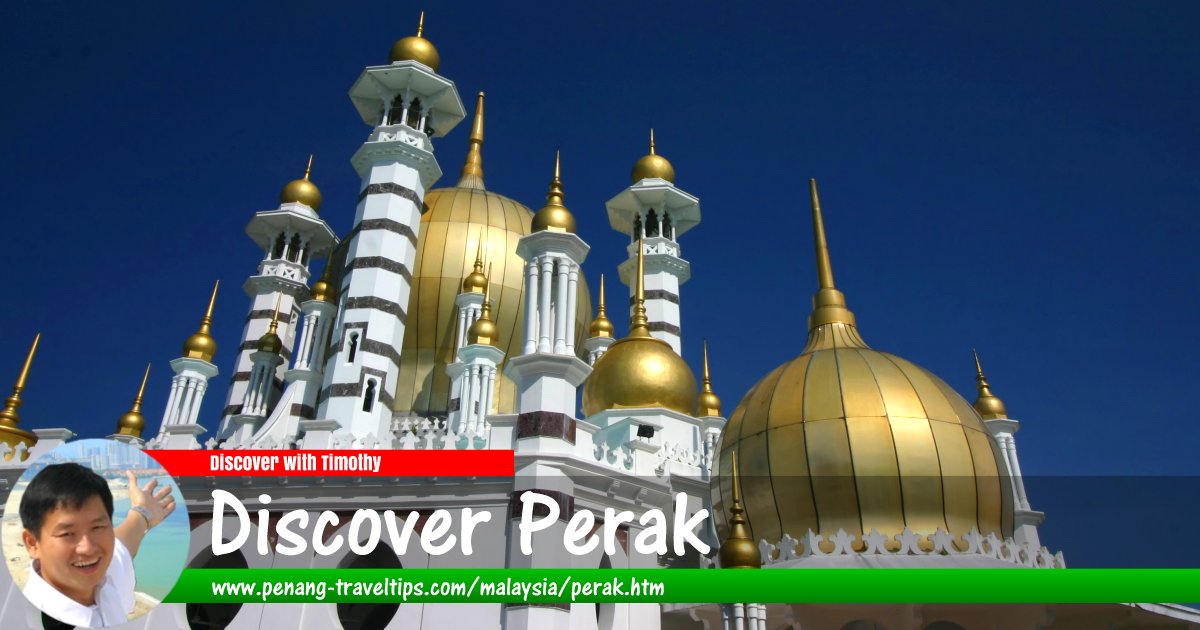 Discover Perak (31 January, 2006)
Also available: Panduan Melawat Perak
Perak is one of the most historically rich, geographically diverse, and culturally vibrant states in Malaysia. Situated on the western coast of Peninsular Malaysia, Perak—which translates to "silver" in Malay—derives its name from the brilliant silvery sheen of its vast tin ore deposits, a mineral that sparked a global economic boom and transformed the region during the 19th and early 20th centuries. Spanning an area of approximately 21,000 square kilometers, it is the fourth-largest state in Peninsular Malaysia, bordered by Kedah and Thailand to the north, Penang to the northwest, Kelantan and Pahang to the east, Selangor to the south, and the Straits of Malacca to the west.1 From the mist-shrouded limestone hills surrounding its royal and administrative capitals to the ancient virgin rainforests of Belum-Temengor and the pristine coastal sanctuaries of Pangkor Island, Perak offers a compelling tapestry of heritage, nature, and world-class culinary traditions for both local explorers and international travelers.
Quick Facts
- State Capital: Ipoh
- Royal Capital: Kuala Kangsar
- Total Land Area: Approximately 21,035 km²
- Population: Over 2.5 million inhabitants
- State Motto: "Laman Web Kerajaan Negeri Perak" / "Perak Sentiasa Di Hati"
- Major Ethnic Groups: Malay, Chinese, Indian, Indigenous Orang Asli
- Primary Languages: Bahasa Malaysia, English, Cantonese, Hokkien, Tamil
- Top Attractions: Ipoh Old Town, Pangkor Island, Royal Belum State Park, Kellie's Castle, Taiping Lake Gardens, Kek Lok Tong Cave Temple
- Local Delicacies: Ipoh White Coffee, Bean Sprout Chicken (Tauge Ayam), Salted Baked Chicken, Chee Cheong Fun, Rendang Tok
- Primary Gateway: Sultan Azlan Shah Airport (IPH), ETS Train Line, North-South Expressway (E1)
An Overview of Perak
The geography of Perak is defined by two major natural landforms: the Titiwangsa Mountain Range, which forms the mountainous spine of Peninsular Malaysia to the east, and the Perak River (Sungai Perak), which flows nearly 400 kilometers from the northern borders down to the Straits of Malacca.2 The river valley served as the historic cradle of Perak human settlement, trade, and royal governance. The state's landscape is famously dotted with majestic karst limestone hills that tower dramatically over lush green plains, creating a surreal and painterly backdrop—particularly around the Ipoh basin.
Historically, Perak was settled by early human populations over tens of thousands of years ago, evidenced by crucial archaeological discoveries in the Lenggong Valley.3 The modern Sultanate of Perak was established in 1528 by Sultan Muzaffar Shah, the eldest son of Sultan Mahmud Shah of the fallen Malacca Sultanate. Throughout the 17th to 19th centuries, the state's immense tin wealth made it a focal point of geopolitical interest, drawing European powers—including the Dutch East India Company and later the British Empire—as well as thousands of Chinese immigrants who arrived to labor in the mines. This massive migration transformed Perak into a multicultural melting pot, leaving behind a unique architectural, linguistic, and culinary legacy that defines the state today.
Geography and Climate
Perak experiences a warm and tropical rainforest climate year-round, characterized by high temperatures, significant humidity, and regular rainfall. Average day temperatures range between 28°C and 33°C, while evenings are generally comfortable and mild. The state experiences two primary monsoon periods: the Southwest Monsoon from May to September and the Northeast Monsoon from November to March.
While travel across Perak is comfortable at almost any time of the year, the heaviest downpours typically occur during the inter-monsoon months of April and October. Outdoor enthusiasts planning extensive rainforest trekking in Belum-Temengor or cave exploration in Gopeng will find the driest months between June and August to be ideal. Island destinations like Pangkor remain accessible year-round due to the protective sheltering effect of Sumatra across the Straits of Malacca.
Major Regions and Towns in Perak
To fully appreciate Perak, one must explore its distinct towns and districts, each carrying its own distinct character, heritage, and atmosphere.
Ipoh: The Capital of Heritage and Gastronomy
Once a sleepy tin-mining outpost, Ipoh blossomed into one of the richest cities in Southeast Asia during the tin boom of the late 19th century. Today, Ipoh stands as the administrative capital of Perak and a premier tourist destination renowned for its grand British colonial architecture, historic shophouses, street art, and legendary culinary scene.4 The city is geographically split into two main sections by the Kinta River: Ipoh Old Town and Ipoh New Town.
Old Town retains its timeless charm, featuring iconic structures such as the Ipoh Railway Station (affectionately termed the "Taj Mahal of Ipoh"), the Birch Memorial Clock Tower, and Concubine Lane—a narrow, bustling alleyway originally developed by tin tycoon Yau Tet Shin. Today, Concubine Lane is packed with vibrant artisan boutiques, souvenir shops, and local snack stalls. Beyond its architectural beauty, Ipoh is world-famous for its food culture, anchored by its smooth, aromatic Ipoh White Coffee, signature crunchy bean sprouts, and rich noodle dishes.
Kuala Kangsar: The Royal Seat of Perak
Located roughly 35 kilometers northwest of Ipoh sits Kuala Kangsar, the official royal town of Perak since the late 19th century. Situated on a serene bend along the Perak River, Kuala Kangsar exudes elegance, tranquility, and regal majesty. The town is home to several of Malaysia's most celebrated architectural landmarks:
- Ubudiah Mosque: Designed by British architect Arthur Benison Hubback and completed in 1917, this breathtaking structure features gleaming golden domes and grand Italian marble minarets, widely considered one of the most beautiful mosques in Malaysia.
- Istana Kenangan: Also known as the Bamboo Palace, this remarkable wooden palace was built in 1926 without using a single metal nail. It features intricate woven bamboo walls and traditional Malay architectural craftsmanship.
- Istana Iskandariah: The official residence of the Sultan of Perak, an imposing palace blending Islamic-Moorish and Art Deco architectural styles set amid manicured gardens.
- Victoria Bridge: Located nearby in Karai, this single-track railway truss bridge was built in 1900 and stands as one of the oldest railway bridges in Malaysia.
Taiping: The Town of Firsts
Nestled at the foot of Maxwell Hill (Bukit Larut), Taiping is historic, lush, and peaceful. Known as the "Town of Firsts," Taiping was developed by the British after the signing of the Pangkor Treaty in 1874 and holds more than 30 national historic firsts, including Malaysia's first public park, first railway line, first museum, first jail, and first public library.5
The crown jewel of the town is the Taiping Lake Gardens. Established in 1880 on the site of an abandoned tin mine, the park spans over 64 hectares of tranquil lakes, historic bridges, and majestic ancient rain trees (Samanea saman) whose giant branches bend gracefully downward to touch the water's surface. Adjacent to the gardens is the Taiping Zoo & Night Safari, one of the top zoological parks in the region, and Bukit Larut, Malaysia's oldest hill station, offering cool mountain air and panoramic views of the coast.
Pangkor Island: Coastal Paradise and Marine Heritage
Situated off the coast of Lumut, Pangkor Island (Pulau Pangkor) is Perak's premier island getaway. Historically a haven for fishermen, traders, and pirates, Pangkor is famous for its scenic golden beaches, clear waters, and laid-back fishing villages. Popular spots like Teluk Nipah and Pasir Bogak offer excellent swimming, snorkeling, kayaking, and hornbill-watching opportunities. Offshore sits Pangkor Laut, a private island resort renowned globally for its luxury accommodation nestled within pristine rainforest and overwater villas.
Gopeng and Kampar: Adventure and Mining History
South of Ipoh lie Gopeng and Kampar, former boomtowns deeply rooted in tin-mining heritage that have rebranded into hubs for education and eco-adventure. Gopeng is famous for its adrenaline-pumping outdoor activities centered around the Kampar River, including white-water rafting, river tubing, waterfall abseiling, and spelunking through Gua Tempurung—one of the largest limestone cave systems in Peninsular Malaysia.6 Kampar, home to the sprawling Universiti Tunku Abdul Rahman (UTAR) campus, features the Kinta Tin Mining (Gravel Pump) Museum, preserving the history of tin miners who shaped the state.
Teluk Intan: Historic Trading Port
Located in southern Perak along the Perak River, Teluk Intan (formerly known as Teluk Anson) is a historic riverine town best known for the Leaning Tower of Teluk Intan. Built in 1885 by Chinese contractor Leong Choon Cheong, this 25.5-meter pagoda-style clock tower leans markedly to one side due to soft underground soil conditions and the weight of its large top-floor water tank, drawing comparisons to Italy's Leaning Tower of Pisa.
Natural Wonders and Eco-Tourism
Perak is blessed with extraordinary biodiversity, ancient ecosystems, and protected wilderness reserves that cater to nature lovers and adventure seekers alike.
Royal Belum State Park
Dating back over 130 million years, the Royal Belum State Park is one of the oldest rainforests in the world—predating even the Amazon and the Congo basins. Spanning more than 117,000 hectares in northern Perak, this vast virgin forest is a biodiversity hotspot, harboring rare species such as the Malayan tiger, Asian elephant, Malayan tapir, and the elusive cloud leopard.7 It is also one of the few places on Earth where all 10 species of Malaysian hornbills can be observed. Visitors can explore Lake Temengor, hike to hidden waterfalls, discover wild Rafflesia blooms, and visit authentic indigenous Orang Asli (Jahai tribe) settlements.
Lenggong Valley UNESCO World Heritage Site
Inscribed as a UNESCO World Heritage Site in 2012, the Lenggong Valley is one of the most important archaeological areas in Southeast Asia.3 The valley holds a rich open-air record of human habitation spanning nearly two million years. It is most famous for the discovery of "Perak Man" in 1991—the most complete prehistoric human skeleton found in Southeast Asia, dated to around 10,000–11,000 years ago. The Lenggong Archaeological Museum displays key artifacts, stone tools, and cave excavations that document early hominin history.
Limestone Caves and Cave Temples
Perak's dramatic karst formations host dozens of breathtaking natural caves and century-old rock temples built within cavernous limestone chambers:
- Gua Tempurung: Stretching over 4.5 kilometers, this cavern system features massive natural domes, stalactites, stalagmites, and underground stream passages. Tours range from easy dry walking paths to challenging wet adventure crawls.
- Kek Look Tong Cave Temple: Located in Gunung Rapat, Ipoh, this peaceful cave temple opens into a beautifully landscaped zen park featuring a lotus lake, reflexology paths, and paddle boats.
- Sam Poh Tong: Established in the late 19th century, Sam Poh Tong is one of the oldest and largest cave temples in Ipoh, featuring intricate Buddha statues, a courtyard, and a famous turtle liberation pond.
- Perak Tong: Built in 1926, this temple is famous for its massive 12.8-meter seated Buddha statue and hundreds of colorful wall murals depicting Buddhist deities and landscapes painted inside the cave walls.
Historical Milestones and Architecture
Perak played an instrumental role in shaping modern Malaysian history. The discovery of rich tin deposits in the Larut region in 1848 by Long Jaafar triggered unprecedented economic growth, but also sparked fierce territorial disputes among secret societies (the Larut Wars) and succession rivalries within the Perak royal court. This instability prompted British intervention, culminating in the historic Pangkor Treaty of 1874 signed aboard the HMS Pluto.8 The treaty marked the formal beginning of British political dominance over the Malay States, introducing the British Resident system, with J.W.W. Birch appointed as Perak's first Resident.
The state's architectural landscape reflects this rich history. Beyond the royal treasures of Kuala Kangsar and colonial institutions of Taiping, Perak holds intriguing architectural oddities like Kellie's Castle in Batu Gajah. Built by Scottish planter William Kellie Smith in the early 20th century for his wife, this grand mansion blended Moorish, Greco-Roman, and Indian architectural styles. Construction ground to a sudden halt when Smith died unexpectedly of pneumonia in Europe in 1926. Today, the partially completed, atmospheric mansion stands as a captivating historical attraction wrapped in local legends and ghost folklore.
Culture, Heritage, and Food
Perak's unique demographic composition has fostered a rich cultural tapestry where Malay, Chinese, Indian, and indigenous Orang Asli customs coexist harmoniously. This cross-cultural heritage is nowhere more evident than in Perak's world-famous food scene.
Must-Try Local Culinary Delights
Ipoh is universally acknowledged as one of Southeast Asia's ultimate food capitals. Its unique karst limestone geology saturates the local groundwater with rich minerals, which locals credit for producing the exceptionally smooth rice noodles (hor fun) and plump, crunchy bean sprouts that make Ipoh dishes unmatched.
- Ipoh White Coffee: Coffee beans roasted with palm oil margarine, brewed with precision, and served with sweetened condensed milk to produce a rich, creamy, frothy cup.
- Nga Choi Kai (Bean Sprout Chicken): Poached chicken served with a plate of crunchy bean sprouts lightly tossed in light soy sauce and sesame oil, accompanied by fragrant rice or flat rice noodles (Kai See Hor Fun).
- Kai See Hor Fun: Silky flat rice noodles served in a savory soup boiled from chicken bones and prawn heads, topped with shredded chicken, chives, and fresh prawns.
- Salted Baked Chicken (Ayam Garam): Whole free-range chicken marinating in traditional Chinese herbs, wrapped in wax paper, and baked packed under coarse rock salt.
- Chee Cheong Fun: Steamed rice noodle rolls served Ipoh-style with sweet red sauce, chili sauce, pickled green chilies, fried shallots, and toasted sesame seeds.
- Rendang Tok: A prized Perak Malay ceremonial dish made of tender beef slow-cooked for hours in coconut milk, palm sugar, toasted coconut (kerisik), and deep aromatic spices until rich, dark, and dry.
Getting to and Around Perak
Perak is well-connected by modern road, rail, and air transit networks, making travel convenient for domestic and international visitors.
By Road
The North-South Expressway (E1) runs directly through the length of Perak, linking Ipoh and other primary towns seamlessly with Kuala Lumpur to the south (approx. 2 to 2.5 hours driving) and Penang to the north (approx. 1.5 to 2 hours driving). Excellent secondary state roads extend connectivity eastward toward Cameron Highlands and northeast toward Kelantan via the East-West Highway (Route 4).
By Train
The Electric Train Service (ETS) operated by KTMB offers an efficient, comfortable, and scenic travel option. Frequent daily trains link Kuala Lumpur Sentral and Butterworth (Penang) to key stations across Perak, including Tanjong Malim, Kampar, Ipoh, Kuala Kangsar, and Taiping. The journey from Kuala Lumpur to Ipoh via ETS takes approximately 2 hours and 40 minutes.
By Air
The state is served by Sultan Azlan Shah Airport (IPH) in Ipoh, which handles daily direct flights from key regional hubs, including Singapore and Johor Bahru.
Conclusion and Travel Tips
Whether you are seeking historic charm along the colonial streets of Ipoh and Taiping, culinary adventures in local kopitiams, thrilling nature excursions through 130-million-year-old rainforests, or quiet coastal relaxation on Pangkor Island, Perak stands out as a complete, highly rewarding destination. It seamlessly bridges old-world heritage with natural beauty, offering authentic experiences for every traveler.
Map of Towns in Perak
Towns of Perak
- Ipoh - state capital (GPS: 4.60085, 101.07769)

- Kuala Kangsar - royal town (GPS: 4.77352, 100.94169)

- Ayer Tawar (GPS: 4.30002, 100.75904)

- Bagan Datoh (GPS: 3.99047, 100.78599)

- Bagan Panchor (GPS: 4.52521, 100.65343)

- Bagan Serai (GPS: 4.52521, 100.65343)

- Bandar Seri Iskandar (GPS: 4.35861, 100.9664)

- Batu Gajah (GPS: 4.47066, 101.04228)

- Batu Kurau (GPS: 4.97466, 100.79475)

- Behrang (GPS: 3.75596, 101.49963)

- Beruas (GPS: 4.49941, 100.78256)

- Bidor (GPS: 4.10982, 101.28725)

- Bota (GPS: 4.35051, 100.93122)

- Bota Kanan (GPS: 4.34843, 100.8828)

- Bukit Berapit (GPS: 5.74405, 101.02381)

- Bukit Berapit (GPS: 5.0328, 100.64901)

- Changkat Jering (GPS: 4.78729, 100.72154)

- Chemor (GPS: 4.71518, 101.12091)

- Chenderiang (GPS: 4.26475, 101.23798)

- Gerik (GPS: 5.42974, 101.12743)

- Gopeng (GPS: 4.47143, 101.16648)

- Jelapang (GPS: 4.63746, 101.05939)

- Jeram (GPS: 4.38654, 101.15567)

- Jerlun (GPS: 4.73242, 100.91268)

- Kampar (GPS: 4.30567, 101.15215)

- Kamunting (GPS: 4.88718, 100.7302)

- Kuala Gula (GPS: 4.93456, 100.46462)

- Kuala Kurau (GPS: 5.01724, 100.43083)

- Kuala Sepetang (GPS: 4.83809, 100.63008)

- Langkap (GPS: 4.0718, 101.14597)

- Lenggong (GPS: 5.10667, 100.96469)

- Lumut (GPS: 4.23514, 100.63167)

- Malim Nawar (GPS: 4.35803, 101.12185)

- Mambang Di Awan (GPS: 4.26734, 101.14774)

- Manong (GPS: 4.59404, 100.88024)

- Matang (GPS: 4.81816, 100.67356)

- Menglembu (GPS: 4.5659, 101.04752)

- Padang Rengas (GPS: 4.77565, 100.84773)

- Pangkor (GPS: 4.22555, 100.56138)

- Pantai Remis (GPS: 4.45441, 100.62978)

- Papan (GPS: 4.50814, 101.01757)

- Parit (GPS: 4.4758, 100.90856)

- Parit Buntar (GPS: 5.11864, 100.48679)

- Pasir Salak (GPS: 4.1367, 100.91182)

- Pengkalan Hulu (GPS: 5.70566, 100.99885)

- Proton City (GPS: 3.73596, 101.51079)

- Pusing (GPS: 4.49497, 101.0107)

- Sayong (GPS: 4.74358, 100.95972)

- Selama (GPS: 5.21745, 100.69227)

- Semanggol (GPS: 4.94986, 100.62944)

- Seri Manjung (GPS: 4.19482, 100.66446)

- Simpang (GPS: 4.81855, 100.70707)

- Simpang Pulai (GPS: 4.52872, 101.12816)

- Sitiawan (GPS: 4.21665, 100.69381)

- Slim River (GPS: 3.82897, 101.40243)

- Sungai Siput (GPS: 4.81936, 101.07593)

- Sungkai (GPS: 3.99971, 101.30664)

- Taiping (GPS: 4.85152, 100.74085)

- Tambun (GPS: 4.61372, 101.14382)

- Tanjung Malim (GPS: 3.70564, 101.50431)

- Tanjung Piandang (GPS: 5.07599, 100.3854)

- Tanjung Rambutan (GPS: 4.6627, 101.17395)

- Tanjung Tualang (GPS: 4.30241, 101.03988)

- Tapah (GPS: 4.19696, 101.25875)

- Teluk Intan (GPS: 4.02215, 101.02409)

- Terung (GPS: 4.70817, 100.71819)

- Trolak (GPS: 3.8908, 101.37805)

- Tronoh (GPS: 4.4224, 100.99147)

- Ulu Kinta (GPS: 4.63601, 101.14713)

Map of Perak Tourist Attractions
Sights in Perak
- Bota Kanan Tuntung Conservation Centre (GPS: 4.34927, 100.88027)
- Beruas Museum (GPS: 4.50125, 100.78023)
- Bukit Merah Laketown Resort
- Concubine Lane (GPS: 4.59632, 101.07794)
- Dutch Fort (GPS: 4.20046, 100.5761)
- Felda Residence Hot Springs
- Gua Kandu
- Gua Tambun (GPS: 4.41679, 101.18762)

- Gua Tempurung (GPS: 4.41679, 101.18762)
- Gunung Korbu (GPS: 4.68333, 101.29999)
- Istana Kenangan
- Istana Ulu
- Kellie's Castle (GPS: 4.47437, 101.08778)
- Kota Ngah Ibrahim
- Lata Iskandar Waterfall
- Lata Kinjang Waterfall
- Leaning Tower of Teluk Intan (GPS: 4.02523, 101.01934)
- Lenggong Archaeological Museum (GPS: 5.05462, 100.97396)
- Lost World of Tambun
- Matang Mangrove Forest Reserve (GPS: 4.83914, 100.63504)
- Maxwell Hill
- Pangkor
- Pasir Salak Historical Complex
- Perak Museum (GPS: 4.86016, 100.74553)
- Sam Poh Tong Temple (GPS: 4.5643, 101.1151)
- Segari Turtle Hatchery
- Sungkai Perak Wildlife and National Parks Department (GPS: 4.03232, 101.3693)
- Taiping Lake Gardens
- Taiping Zoo (GPS: 4.85491, 100.75142)
- Tanjung Tualang Tin Dredge (GPS: 4.39663, 101.05316)
- Ubudiah Royal Mosque (GPS: 4.76414, 100.95045)
Categories of Sights in Perak
- IPOH
- TOWNS IN PERAK
- Beaches in Perak
- Brethren Assemblies in Perak
- Bridges in Perak
- Bus Terminals in Perak
- Caves in Perak
- Cave Temples in Perak
- Cemeteries in Perak
- Chinese Temples in Perak
- Churches in Perak
- Clan Associations in Perak
- Clocktowers in Perak
- Dialysis Centres in Perak
- Forest Parks in Perak
- Forts in Perak
- Golf Courses in Perak
- Government Buildings in Perak
- Gurdwaras in Perak
- Hawker Centres in Perak
- Hills in Perak
- Hindu Temples in Perak
- Historic Buildings in Perak
- Hospitals in Perak
- Hotel Stays in Perak
- Hotels in Perak
- Islands in Perak
- Jetties in Perak
- Markets in Perak
- Mausoleums in Perak
- Monuments in Perak
- Mosques in Perak
- Mountains in Perak
- Museums in Perak
- Palaces in Perak
- Parks in Perak
- Petrol Stations in Perak
- Police Stations in Perak
- Recreation Clubs in Perak
- Restaurants in Perak
- Rivers in Perak
- Schools in Perak
- Shopping Malls in Perak
- Streets in Perak
- Swimming Pools in Perak
- Thai Temples in Perak
- Tourist Attractions in Perak
- Train Stations in Perak
- Universities in Perak
- Waterfalls in Perak
- Waterfront Promenades in Perak
Districts in Perak
- Batang Padang District
- Hilir Perak District
- Hulu Perak District
- Kampar District
- Kerian District
- Kinta District
- Kuala Kangsar District
- Larut, Matang & Selama District
- Manjung District
- Perak Tengah District
References
- Perak State Government Official Portal. https://www.perak.gov.my
- Department of Statistics Malaysia (DOSM) - Perak State Profile. https://www.dosm.gov.my
- UNESCO World Heritage Centre - Archaeological Heritage of the Lenggong Valley. https://whc.unesco.org/en/list/1396/
- Ipoh City Council (Majlis Bandaraya Ipoh). https://www.mbi.gov.my
- Taiping Municipal Council (Majlis Perbandaran Taiping). https://www.mpt.gov.my
- Tourism Perak Official Website. https://www.tourismperakmalaysia.com
- Perak State Parks Corporation - Royal Belum. https://www.royalbelum.my
- National Archives of Malaysia - Treaty of Pangkor 1874. https://www.arkib.gov.my
Page Details
This page was created on 23 July 2026. Hi, my name is Timothy and created it from my research, for my own entertainment, knowledge and to satisfy my curiosity. I am providing the information to you in good faith and hope it is useful. I try to get the details as accurate as possible. I also try to update the page whenever I stumble on new details. So this and all my other pages are perpetual work in progress. If you discover any error, please politely inform me, pointing out where the error lies, and I will correct it as soon as possible. Your helpfulness will keep this page accurate, relevant and helpful to those who need the information.My Videos of Malaysia
 Latest Pages & Updates
Buy Me A Coffee
If you enjoy the information I provide and want to support the work I do, please buy me a coffee! I appreciate it immensely, thank you so much!
