
Jalan Bunga Raya, Malacca
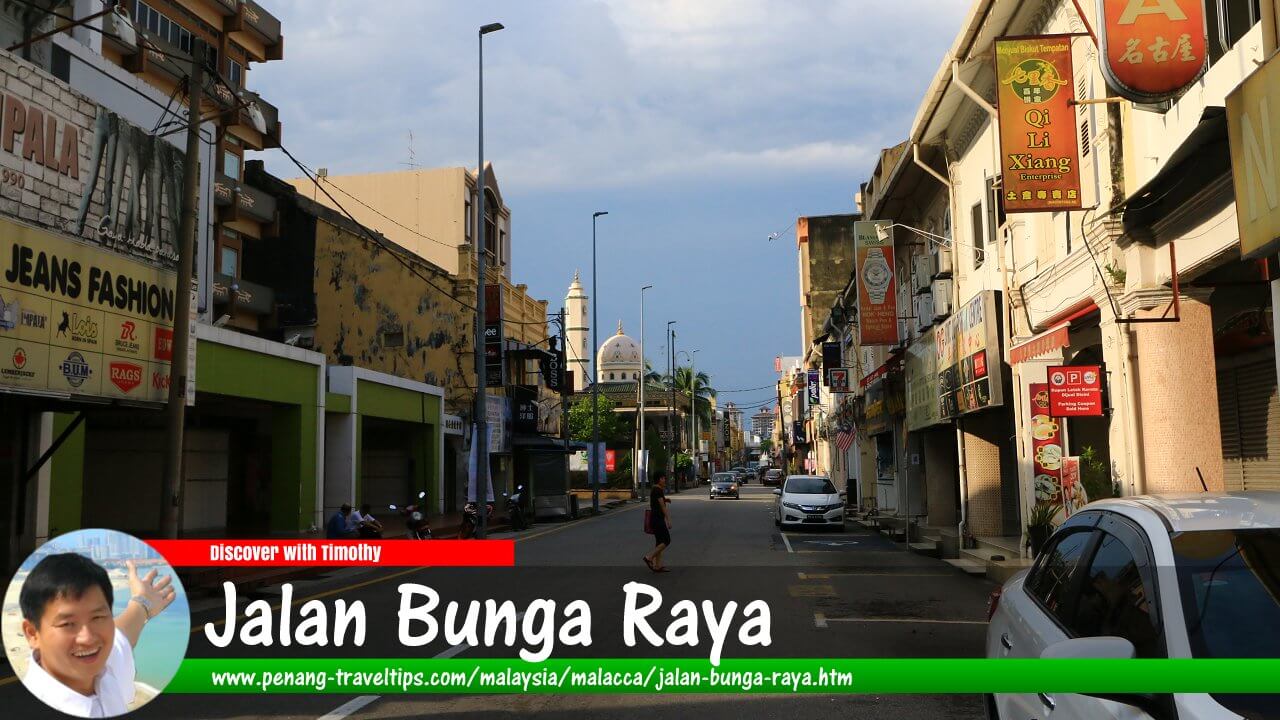 Jalan Bunga Raya, Malacca (10 August 2017)
Also available: Jalan Bunga Raya (Malay Edition)
Jalan Bunga Raya is one of the principal historic roads in Malacca, extending southwards from the edge of the UNESCO World Heritage Site into one of the city's oldest commercial and residential districts. While the streets within the historic core preserve the compact layout of the Dutch colonial town, Jalan Bunga Raya illustrates how Malacca gradually expanded beyond its original boundaries during the late nineteenth and twentieth centuries. Today, the road remains an important urban corridor where historic shophouses, religious buildings, long-established businesses and modern commercial premises coexist, reflecting the city's continuing evolution.1
Quick Facts
- Location: Historic City of Malacca, Malaysia
- Length: Approximately 1 kilometre
- Route: Extends southwards from Jalan Bendahara towards Jalan Bunga Raya Pantai and the southern districts of the city.
- Former role: Southern approach to the historic town and an important commercial corridor.
- Present character: Mixed commercial, residential and heritage street.
- Known for: Historic shophouses, traditional businesses, religious diversity and local eateries.
- UNESCO status: Northern section lies adjacent to the core zone of the Historic City of Malacca World Heritage Site.
An Historic Southern Approach
Unlike many of the narrow streets that developed within the fortified Dutch settlement, Jalan Bunga Raya owes its importance to movement. For generations it served as one of the principal routes leading into the southern side of Malacca Town, linking the historic commercial centre with expanding residential neighbourhoods, agricultural hinterland and, in later years, new suburbs that developed beyond the traditional urban limits. Its history is therefore inseparable from the physical growth of the city itself.2
Although visitors often associate Malacca primarily with the streets surrounding Dutch Square and the old waterfront, urban life has never been confined to the colonial core alone. As trade expanded and the population increased during the nineteenth century, commercial activity gradually spread beyond the older quarters. Jalan Bunga Raya emerged as one of the principal corridors through which this expansion took place, accommodating shops, residences, workshops and community institutions that supported the growing town.3
Even today, a walk along Jalan Bunga Raya reveals a gradual transition between different periods of Malacca's history. The northern end remains closely connected with the historic centre, while the southern sections display the architecture and commercial character of a town that continued to develop well into the twentieth century. This progression makes the road an excellent illustration of how historic cities evolve without entirely losing their earlier identity.
Historical Development
The origins of Jalan Bunga Raya are closely linked to the gradual expansion of Malacca beyond the limits of the old colonial settlement. During the Portuguese and Dutch periods, most administrative, military and commercial activities were concentrated around the fortified town and the river. Residential areas and agricultural land extended beyond these confines, connected by roads that gradually assumed greater importance as the population increased.4
By the nineteenth century, following the establishment of British administration in the Straits Settlements, Malacca experienced a period of steady urban growth. Although it no longer possessed the international prominence that it had enjoyed during the sixteenth century, the town continued to function as an important regional trading centre. New businesses were established beyond the historic core, while improved roads encouraged development further south. Jalan Bunga Raya became one of the principal axes along which this expansion occurred.5
The road gradually attracted a wide variety of businesses that served both local residents and traders travelling into town. Traditional provision shops stood alongside workshops, food establishments, goldsmiths, pharmacies and family-owned enterprises. Many of these businesses occupied two-storey shophouses that combined commercial premises on the ground floor with family accommodation above, a pattern of development characteristic of many historic towns throughout the Malay Peninsula.6
Unlike the carefully planned streets of the Dutch administrative quarter, development along Jalan Bunga Raya responded more directly to changing economic circumstances. Buildings were constructed over many decades, producing a varied streetscape in which late nineteenth-century shophouses stand beside structures dating from the inter-war years and the decades following the Second World War. Rather than diminishing the character of the street, this architectural diversity documents successive phases in the city's development.
The Origin of the Name
The present name, Jalan Bunga Raya, commemorates the bunga raya (Hibiscus rosa-sinensis), Malaysia's national flower. The hibiscus was officially adopted as the national flower in 1960, shortly after the Federation of Malaya achieved independence, and many roads throughout the country subsequently received names reflecting national symbols and identity.7
The choice of the name represents a departure from the colonial practice of naming streets after European officials or descriptive geographical features. Instead, it reflects the post-independence movement to establish a civic landscape that recognised national heritage and local identity. Although the road itself predates the adoption of its present name by many decades, its modern designation symbolises Malacca's place within an independent Malaysia while preserving the historical importance of the street itself.
The name also reflects a broader trend in Malaysian urban toponymy during the second half of the twentieth century, when numerous streets acquired names associated with native flora, national leaders and historical figures. In Malacca, this process produced a city in which colonial-era streets coexist with post-independence place names, each representing a different chapter in the country's history.8
A Street Between Two Worlds
One of the defining characteristics of Jalan Bunga Raya is its position between two distinct urban landscapes. To the north lies the compact historic town, where narrow streets, conserved shophouses and centuries-old places of worship reflect Malacca's colonial past. Travelling southwards, the urban fabric gradually changes. Buildings become more varied in age and design, roads widen, and commercial activities increasingly reflect the needs of a modern Malaysian city.
This gradual transition is perhaps Jalan Bunga Raya's greatest historical significance. Rather than representing a single period of development, the road records the continuous expansion of Malacca over more than a century. Each generation has left its mark upon the streetscape, creating an urban environment in which heritage buildings stand alongside later commercial premises without entirely obscuring the historical pattern of the road.9
For this reason, Jalan Bunga Raya should not be regarded merely as a road leading away from the UNESCO World Heritage Site. It is itself an important historical landscape that demonstrates how Malacca evolved from a compact colonial port into the modern state capital while retaining many physical reminders of its earlier development.
Architecture and Streetscape
The architectural character of Jalan Bunga Raya reflects more than a century of continuous urban development. Unlike the remarkably uniform streets within the Dutch-era civic quarter, the buildings along Jalan Bunga Raya represent successive phases in Malacca's growth, resulting in a varied yet harmonious streetscape. Two-storey shophouses remain the dominant building type, although their façades display a wide range of architectural influences dating from the late nineteenth century through the decades following the Second World War.10
Many of the older shophouses were constructed using traditional masonry walls, timber upper floors and clay roof tiles. Decorative plasterwork, timber shutters, ornamental ventilation panels and five-foot ways are common features, although individual buildings often display distinctive details that reflect the tastes and financial circumstances of their original owners. As the street developed during the twentieth century, newer buildings adopted simplified façades influenced by the Art Deco and early Modern styles, illustrating changing architectural fashions without entirely replacing the earlier streetscape.
One of Jalan Bunga Raya's greatest strengths lies in this architectural diversity. Rather than presenting a single historical period, the street allows observers to trace the gradual evolution of Malacca's commercial architecture over several generations. Older buildings stand beside later structures, each representing a different stage in the city's economic and social development.11
A Living Commercial Street
For well over a century, Jalan Bunga Raya has functioned as one of Malacca's most important neighbourhood shopping streets. Unlike purpose-built commercial centres, its businesses developed organically in response to the needs of surrounding communities. This pattern of gradual growth produced a lively mixture of retail shops, food establishments, workshops, professional services and family-owned enterprises that continues to characterise the road today.
Historically, many businesses along Jalan Bunga Raya occupied traditional shophouses in which commercial activities were conducted on the ground floor while the proprietor's family lived upstairs. This arrangement encouraged close relationships between business owners and the surrounding community, with many establishments serving several generations of local residents. Even where ownership has changed, the mixed residential and commercial character remains one of the defining features of the street.12
Traditional trades continue to coexist with newer businesses. Long-established coffee shops, traditional bakeries, pharmacies, hardware stores and neighbourhood retailers share the streetscape with cafés, convenience stores, professional offices and modern service industries. This coexistence illustrates the gradual adaptation of the street to changing economic conditions rather than wholesale redevelopment.
Unlike shopping districts designed around large-scale retail developments, Jalan Bunga Raya retains a distinctly human scale. Individual shopfronts remain relatively narrow, encouraging a rhythm of small businesses rather than large commercial complexes. This pattern contributes significantly to the street's historic character and reflects the traditional urban form of Malacca.13
A Community of Many Cultures
Throughout its history, Jalan Bunga Raya has been home to people from a wide variety of cultural backgrounds. Chinese, Malay, Indian, Peranakan and Eurasian communities have all contributed to the development of the surrounding neighbourhoods, creating a social landscape that mirrors the multicultural history of Malacca itself.14
This diversity is reflected not only in the people who have lived and worked along the street but also in the architecture, religious buildings and businesses that developed over time. Temples, mosques, churches and clan associations can all be found within the wider vicinity, demonstrating the long tradition of religious coexistence that has characterised Malacca since its days as an international trading port.
The street has also long served as a meeting place where commerce encouraged daily interaction between different communities. Merchants, craftsmen, transport operators, teachers, office workers and residents have all contributed to the distinctive atmosphere that distinguishes Jalan Bunga Raya from streets whose identities are defined primarily by tourism or government administration.
The Rhythm of Daily Life
Unlike the streets within the busiest parts of the UNESCO World Heritage Site, Jalan Bunga Raya follows the rhythm of an ordinary working neighbourhood. Early mornings are marked by traditional coffee shops preparing breakfast, local markets receiving fresh produce and shopkeepers opening their premises for the day's business. Activity continues steadily throughout the day as residents attend to shopping, work and daily errands.
In the evening, restaurants and food outlets become gathering places for families and friends, while many long-established businesses close in accordance with traditional trading hours. This daily rhythm has changed remarkably little despite the introduction of modern retail practices elsewhere in the city. The continued presence of independently owned businesses helps preserve the neighbourhood atmosphere that has long distinguished Jalan Bunga Raya.15
Relationship with Surrounding Streets
Jalan Bunga Raya occupies a strategic position within the southern part of historic Malacca, linking several important roads that collectively illustrate the city's development over different historical periods. To the north, it connects with Jalan Bendahara, providing access towards the historic civic centre and the UNESCO World Heritage Site. Further south, the road continues towards neighbourhoods that developed during the twentieth century as Malacca expanded beyond its colonial-era boundaries.
Numerous smaller streets branch from Jalan Bunga Raya, each contributing to the varied character of the surrounding district. Some retain rows of traditional shophouses and family businesses, while others have gradually developed into predominantly residential streets. Together, they form an interconnected urban landscape in which commercial activity, residential life and community institutions remain closely linked.
Among the most notable side streets is Jalan Bunga Raya Pantai, which preserves many historic buildings and provides an important connection towards the Melaka River. Nearby roads such as Jalan Parameswara, Jalan Bendahara and Jalan Laksamana also illustrate different stages in the city's expansion, allowing observers to appreciate how successive generations shaped the urban form of modern Malacca.16
Beyond the UNESCO Boundary
Although only the northern section of Jalan Bunga Raya lies immediately adjacent to the UNESCO World Heritage Site, the road demonstrates that Malacca's historical significance extends well beyond the officially designated conservation zones. The buildings, communities and commercial activities found here form an important continuation of the city's historical landscape rather than a separate chapter.
This broader perspective is increasingly recognised by historians and conservation specialists, who view the historic city as a series of interconnected neighbourhoods rather than an isolated collection of monuments. Jalan Bunga Raya therefore occupies an important position in understanding not only the heritage core itself but also the wider urban development that surrounded and sustained it over many generations.17
Landmarks Along Jalan Bunga Raya
One of Jalan Bunga Raya's distinguishing characteristics is the variety of historic buildings and community institutions that line the road and its immediate surroundings. Rather than being dominated by a single monumental structure, the street derives its significance from the collective presence of historic shophouses, places of worship, schools, community organisations and long-established businesses. Together, these elements illustrate how the district developed as one of Malacca's most important urban neighbourhoods.18
Unlike the ceremonial spaces surrounding Dutch Square, Jalan Bunga Raya evolved primarily to serve the everyday needs of residents. Its landmarks therefore tend to reflect daily life rather than colonial administration. Schools educated successive generations of local children, religious institutions served neighbourhood congregations, while rows of traditional shophouses provided goods and services for families living throughout the district. These functions continue to shape the identity of the street today.
Historic Shophouses
The historic shophouses remain the defining architectural feature of Jalan Bunga Raya. Although individual buildings differ in age and appearance, together they illustrate more than a century of commercial development. Many retain original timber shutters, decorative plasterwork, ceramic air vents and traditional five-foot ways that continue to shelter pedestrians from the tropical sun and rain.19
Several buildings have undergone careful restoration while others continue to serve their original commercial purpose with relatively few alterations. The result is a streetscape that feels authentic rather than reconstructed, where historic buildings remain part of everyday urban life instead of functioning solely as museum exhibits.
Religious Heritage
The neighbourhood surrounding Jalan Bunga Raya reflects Malacca's long tradition as a multicultural trading port. Chinese temples, Muslim mosques, Christian churches and Hindu temples are all found within walking distance of the street, each representing communities that contributed to the city's development over many generations.20
This close proximity of different places of worship demonstrates that the district developed as a shared urban environment rather than a collection of isolated ethnic enclaves. Religious buildings served not only spiritual needs but also functioned as centres of education, charity and community leadership, reinforcing the social fabric of the surrounding neighbourhood.
Traditional Businesses
Many businesses along Jalan Bunga Raya have remained family-owned for decades, with knowledge and customer relationships passing from one generation to the next. Traditional coffee shops, bakeries, Chinese medicine halls, sundry shops and hardware merchants continue to occupy premises that have served similar purposes for much of the twentieth century.21
These long-established enterprises contribute to the continuity of the street. While ownership and products inevitably evolve over time, the underlying pattern of small independent businesses remains remarkably resilient. It is this continuity that distinguishes Jalan Bunga Raya from newer commercial districts characterised by shopping malls and chain retailers.
The Street and the Melaka River
Although Jalan Bunga Raya does not follow the course of the Melaka River, its history has always been closely connected with it. For centuries, the river served as the principal transportation artery of the town, carrying goods between the harbour, warehouses and commercial quarters. Roads such as Jalan Bunga Raya enabled merchandise arriving by water to be distributed to neighbourhoods further inland, while agricultural produce from the surrounding countryside reached the riverfront through the same network of streets.22
As road transport gradually replaced river traffic during the twentieth century, Jalan Bunga Raya assumed an even greater role in the movement of people and goods. Motor vehicles, buses and commercial lorries increasingly relied upon the road, reinforcing its importance as one of the city's principal urban corridors.
Education and Community Life
Beyond commerce, Jalan Bunga Raya has long played an important role in the educational and social development of Malacca. Schools established within the surrounding district provided instruction to generations of children from different communities, while community halls, associations and charitable organisations strengthened neighbourhood ties through educational, cultural and welfare activities.23
Many of these institutions were founded by local communities themselves rather than by government authorities. Their continued presence illustrates the tradition of civic participation that has long characterised Malacca, where education and mutual assistance were often supported through voluntary associations and philanthropic contributions.
Changing Urban Landscape
The appearance of Jalan Bunga Raya has inevitably changed over the decades as new buildings replaced older structures and businesses adapted to changing economic conditions. Nevertheless, the road has avoided the wholesale redevelopment that transformed many commercial streets elsewhere in Southeast Asia. Instead, change has generally occurred incrementally, allowing different generations of buildings to coexist within the same urban landscape.24
This gradual evolution is one of the street's greatest historical assets. Rather than preserving a single architectural period, Jalan Bunga Raya documents the continuous growth of Malacca from the late nineteenth century to the present day. Every generation has left visible evidence of its presence, creating an urban record that is unusually complete.
The Character of Jalan Bunga Raya
Perhaps more than any individual building, it is the overall atmosphere of Jalan Bunga Raya that gives the street its distinctive identity. Unlike ceremonial streets designed to impress visitors, this road developed through the everyday activities of merchants, craftsmen, teachers, religious leaders, transport operators and families who collectively shaped the surrounding neighbourhood over many decades.
The result is a street that remains active throughout the day without losing its historical character. Modern businesses occupy premises built for earlier generations, while long-established shops continue to operate alongside newer enterprises. The coexistence of continuity and change reflects the broader story of Malacca itself—a historic city that has repeatedly adapted to new circumstances while preserving much of its inherited urban fabric.25
A Street That Explains Modern Malacca
While many of Malacca's historic streets are valued for preserving individual monuments or architectural ensembles, Jalan Bunga Raya is significant because it demonstrates how a living city develops. It bridges the gap between the colonial-era town and the modern state capital, illustrating that urban history is not confined to a single period or neighbourhood.
For anyone seeking to understand the evolution of Malacca, Jalan Bunga Raya offers an invaluable perspective. Its buildings, businesses and communities reveal how successive generations responded to changing economic opportunities, technological developments and social needs, ensuring that the road has remained one of the city's most important thoroughfares for well over a century.26
Real Estate
Jalan Bunga Raya occupies a distinctive position within Malacca's property market. Unlike the streets inside the UNESCO World Heritage Site, where strict conservation guidelines apply to many historic buildings, Jalan Bunga Raya comprises a mixture of protected heritage properties, traditional pre-war shophouses and more recent commercial buildings. This diversity produces a broader range of property values and development opportunities while retaining much of the street's historic character.27
As of 2026, restored pre-war shophouses along Jalan Bunga Raya and its immediate vicinity generally command asking prices of approximately RM1.8 million to RM5.5 million, depending on their condition, frontage, land area, architectural integrity and proximity to the historic city centre. Exceptionally restored corner properties or buildings suitable for boutique hospitality or food-and-beverage businesses may achieve higher asking prices.28
Most traditional two-storey shophouses provide between 1,800 and 3,500 square feet (approximately 167 to 325 square metres) of built-up space, although larger premises assembled from multiple adjoining lots may exceed these figures. The upper floor was traditionally used as family living quarters, while the ground floor accommodated commercial activities, a layout that continues to suit many modern businesses.
Commercial rental rates vary considerably according to location and condition. As of 2026, restored heritage shophouses in the Jalan Bunga Raya area are commonly advertised for between RM4,000 and RM12,000 per month, while smaller or less extensively renovated premises may command lower rents. Boutique hotels, cafés and specialty retailers have helped sustain demand for well-maintained historic buildings.28
Compared with many newer commercial districts in Malacca, Jalan Bunga Raya appeals particularly to buyers seeking properties with architectural character and historical significance. Investors are often attracted by the area's established reputation, steady pedestrian activity and close proximity to the UNESCO World Heritage Site, while long-time residents continue to value the neighbourhood's convenience and strong sense of community.
Public Transport
Jalan Bunga Raya is readily accessible by road from most parts of Malacca. Although city buses do not travel along every section of the street, several public bus routes serve nearby roads, placing the area within a short walking distance of public transport.29
The nearest bus stops are generally located along Jalan Bendahara, Jalan Munshi Abdullah and the approaches to the historic city centre. These stops are served by a number of Panorama Melaka and stage bus services connecting the district with Melaka Sentral and other parts of the city. For many visitors, the most convenient way to explore Jalan Bunga Raya remains on foot after arriving in the historic centre, as the surrounding streets form an interconnected pedestrian network.
Private vehicles, taxis and e-hailing services also provide convenient access, although traffic conditions and parking availability may vary, particularly during weekends and public holidays when visitor numbers are highest.
Fun Facts
- Although it bears the name of Malaysia's national flower, Jalan Bunga Raya is considerably older than the adoption of the hibiscus as the national flower in 1960. The road itself predates its present name by many decades.30
- Jalan Bunga Raya illustrates the transition between the colonial-era town and twentieth-century Malacca more clearly than almost any other historic road in the city.
- Many family-owned businesses along the street have operated for several generations, contributing to the continuity of the neighbourhood despite changing economic conditions.
- The architectural variety found along Jalan Bunga Raya reflects more than a century of urban development rather than a single period of construction.
- Unlike streets that function primarily as visitor destinations, Jalan Bunga Raya continues to serve as a working commercial street for local residents, preserving much of its traditional role within the city.
Conclusion
Jalan Bunga Raya occupies a unique place in the urban history of Malacca. Whereas the streets within the old colonial core reveal the city's early commercial and administrative foundations, Jalan Bunga Raya demonstrates how that compact settlement gradually expanded into a modern town during the nineteenth and twentieth centuries. Its historic shophouses, neighbourhood businesses, religious institutions and community organisations together record the continuing evolution of one of Malaysia's most historic cities.31
More than simply a thoroughfare, Jalan Bunga Raya is a historical landscape where successive generations have lived, worked and adapted to changing circumstances without entirely erasing the legacy of the past. The coexistence of traditional commerce, historic architecture and contemporary urban life gives the street a character that is distinct from both the carefully conserved heritage core and the newer suburbs beyond. It remains an essential part of understanding the wider story of Malacca.
Jalan Bunga Raya on the Map of Malacca, Malacca
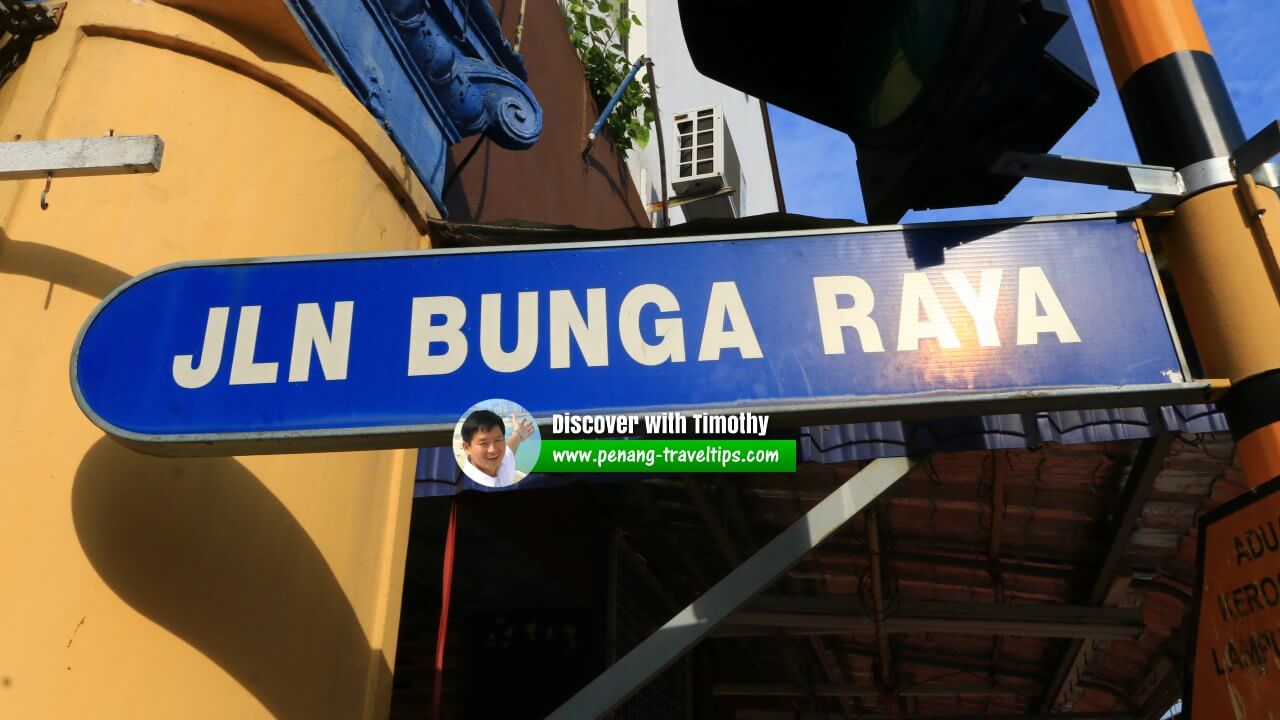 Jalan Bunga Raya roadsign (10 August 2017)
References
- UNESCO World Heritage Centre. Melaka and George Town, Historic Cities of the Straits of Malacca.
- Department of National Heritage (Jabatan Warisan Negara).
- Malacca Historic City Council (Majlis Bandaraya Melaka Bersejarah).
- Perbadanan Muzium Melaka (PERZIM).
- National Archives of Malaysia.
- Dewan Bahasa dan Pustaka.
- Melaka State Government.
- Panorama Melaka.
- PropertyGuru Malaysia.
- EdgeProp Malaysia.
- National Property Information Centre (NAPIC).
Page Details
This page was created on 17 July 2026. Hi, my name is Timothy and created it from my research, for my own entertainment, knowledge and to satisfy my curiosity. I am providing the information to you in good faith and hope it is useful. I try to get the details as accurate as possible. I also try to update the page whenever I stumble on new details. So this and all my other pages are perpetual work in progress. If you discover any error, please politely inform me, pointing out where the error lies, and I will correct it as soon as possible. Your helpfulness will keep this page accurate, relevant and helpful to those who need the information.Streets of Malacca Directory
Want to share your Malacca travel experiences or get tips from fellow travellers?
Join the Malacca Travel Tips Facebook GroupInformation for visiting Malacca
Here are some related articles to help you get to know Malacca better.Introduction to Malacca
Information on buying property or renting in Malacca
 Latest Pages & Updates
Buy Me A Coffee
If you enjoy the information I provide and want to support the work I do, please buy me a coffee! I appreciate it immensely, thank you so much!
